
Member Knowledge Centre
 member Knowledge centre
The Knowledge Centre provides CHBA members with access to information and resources. It is a growing resource that is currently focused on updating members about national building code information. Please note that this information is a benefit of your membership, and should not be shared beyond your company/organization.
You can browse the items below, filter by category, or enter search terms in the "What are you looking for" box below.
This information is provided by CHBA for informational purposes only and cannot be used as an official or authoritative document.
Understanding Arc-Fault Circuit Interrupters (AFCIs)
Understanding Arc-Fault Circuit Interrupters (AFCIs)
 Understanding Arc-Fault Circuit Interrupters (AFCIs)
What Are AFCIs?
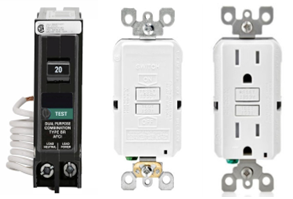 Arc-Fault Circuit Interrupters (AFCIs) are devices designed to detect and interrupt unintended arcing faults in electrical wiring, which can occur when wires are damaged, pinched, or degraded. These arcs may not draw enough current to trip a traditional breaker, but they can generate enough heat to start fires. AFCIs are intended to add a layer of fire protection beyond that provided by standard breakers.
How Do AFCIs Work?
AFCIs monitor the electrical current on a circuit. When they detect patterns associated with potentially dangerous arcing – typically erratic bursts that occur in high frequency – AFCIs shut down the circuit to prevent possible ignition.
There are several types of AFCIs:
- Branch/Feeder AFCIs (circuit breakers installed in panels)
- Combination-type AFCIs (the current standard, offering protection from both series and parallel arcing)
- Outlet Branch Circuit (OBC) AFCIs (installed at the first outlet to protect downstream wiring)
What Is Nuisance Tripping?
“Nuisance tripping” refers to the unintentional shutdown of a circuit by an AFCI when no hazardous condition is present. This is a persistent concern in both new construction and renovations. AFCIs may misinterpret the normal electrical activity of certain devices – such as treadmills, LED lighting, vacuum cleaners, or furnaces – as dangerous arcing, leading to power interruptions that frustrate homeowners and trades alike.
While manufacturers have made improvements, some circuits continue to experience nuisance tripping even with compliant wiring and devices. This can result in service callbacks, homeowner complaints, and in some cases, unauthorized replacement of AFCI devices with standard ones.
What does the Canadian Electrical Code require?
The Canadian Electrical Code (CE Code) began requiring AFCIs in new residential construction in 2002 for bedroom receptacles. Over time, requirements have expanded:
- In the 2015 CE Code, AFCI protection was required for most 120 Volt receptacle circuits in dwelling units.
- Since the 2021 edition of the CE Code, AFCIs are generally required on circuits supplying all 120 Volts receptacles, including those in living rooms, dining rooms, kitchens, and laundry areas.
However, code enforcement varies by province. Some jurisdictions have delayed implementation or issued exemptions. Builders and renovators should check with local code authorities to confirm current requirements.
Key Considerations for Renovators
AFCI requirements often apply to renovations and additions. In many cases, extending or altering an existing circuit may trigger the requirement to install AFCI protection – either at the breaker panel or as an outlet branch AFCI receptacle. This is frequently missed during renovations, especially in basement finishes, kitchen updates, or when adding new receptacles to existing rooms. Renovators should confirm with local inspectors how AFCI provisions are enforced in retrofit work and ensure that AFCI devices are compatible with any existing wiring and connected loads – to void nuisance tripping.
Recent Developments and Ongoing Issues
Newer devices such as dual-function breakers – which combine AFCI and GFCI protection – are now available and increasingly used, especially in areas where both protections are required (e.g., laundry rooms). However, these devices can be even more prone to nuisance tripping than AFCIs alone.
Builders continue to report nuisance tripping associated with:
- Heat pump systems and variable-speed motors
- Certain LED lighting systems and transformers
- Power tools used during construction or by homeowners
Some homeowners, frustrated by repeated outages, replace AFCIs with standard breakers or outlets, unknowingly removing the code-intended protection. If this occurs after inspection, it may shift liability back to the builder or electrician, especially if the original installation didn’t follow code, or if proper documentation was lacking.
What’s the Debate About AFCIs?
Since their introduction, AFCIs have been the subject of considerable debate among electrical trades working in new construction and renovation. While the original intent of including AFCIs in codes was to improve safety by reducing the risk of electrical fires caused by arcing faults, the actual impact of AFCIs – particularly in new construction – remains disputed.
One key point of contention is cost. AFCI breakers are significantly more expensive than standard breakers, often costing 50 to 75 percent more. Equipping an entire new home with AFCIs can add between $800 and $1000 in material costs alone, not including potential labour or troubleshooting time.
More fundamentally, many in the industry question whether AFCIs have delivered the safety benefits promised. While electrical fires remain a concern, the majority of wiring-related fires occur in older homes with aging systems – not in newly constructed homes where wiring must meet modern codes and be professionally inspected. In fact, the overall rate of residential electrical fires in Canada has been declining for decades, raising questions about whether AFCIs represent an essential next step or an increasingly marginal improvement.
The most serious issue raised by contractors and builders relates to unintended consequences. Nuisance tripping continues to be a persistent problem, especially when AFCIs are used with modern appliances, power tools, or lighting systems. Homeowners – frustrated by repeated power outages – may replace AFCI devices with standard breakers or receptacles that do not offer the same protection. In some cases, these substitutions occur without the knowledge of the builder or the electrician, and they may eliminate arc-fault protection entirely. This creates confusion, undermines trust, and can shift liability back onto the contractor or renovator if a future problem occurs.
In short, the ongoing debate about AFCIs is not only about their cost or code status, but also about whether the devices function reliably in real homes, with real occupants, and whether they offer enough benefit to justify the unintended risks and frustrations they can introduce.
Reporting Nuisance Tripping Helps Everyone
If nuisance tripping occurs, contractors, renovators, and trades are encouraged to formally report the issue. This supports efforts by manufacturers, standards bodies, and regulators to improve device performance and compatibility across product types.
📝 Report AFCI nuisance tripping here
(Electro-Federation Canada reporting tool)
Additional Info
Download File : Understanding Arc-Fault Circuit Interrupters (AFCIs).pdf